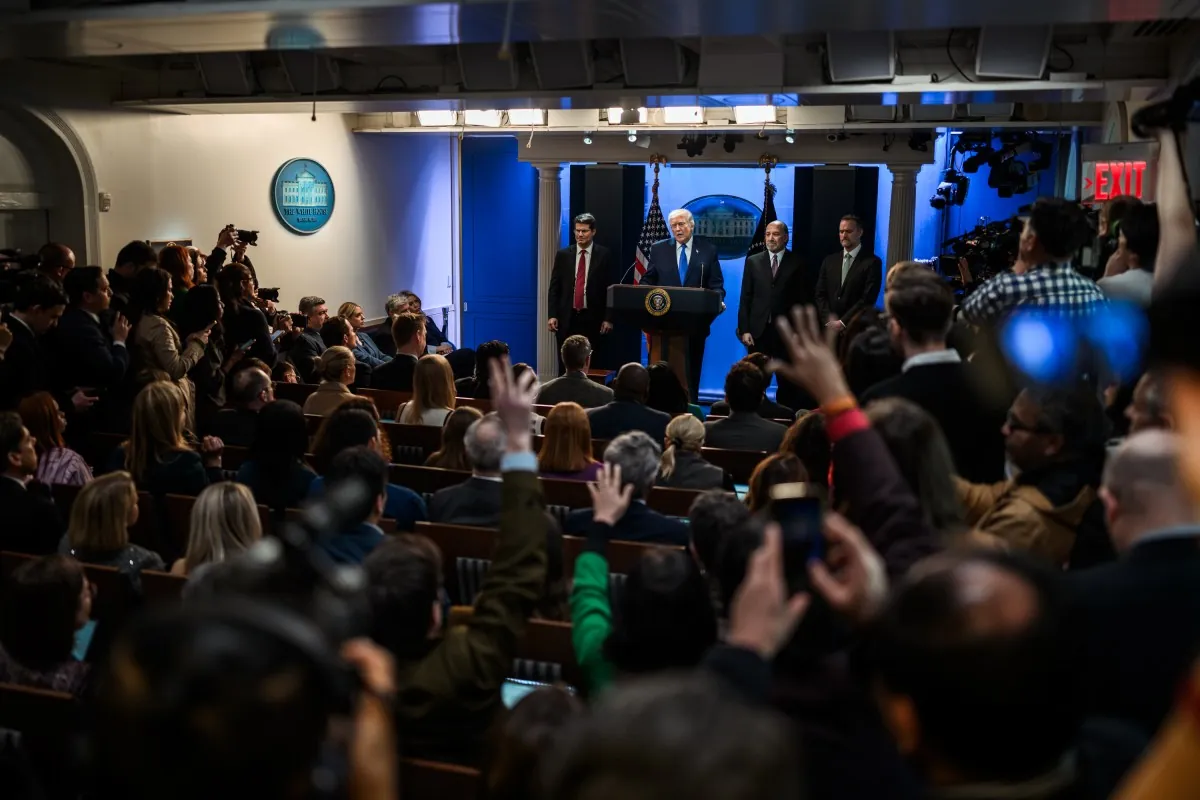
President Donald Trump addresses reporters after the February 20, 2026 Supreme Court tariff ruling. Official White House photo by Daniel Torok. Source.
Short answer: the temporary 10% Section 122 import surcharge is still being collected as of July 14, 2026, but its proclamation says it runs only through 12:01 a.m. EDT on July 24 unless it is changed earlier or Congress extends it. That deadline does not erase the rest of the tariff stack on Chinese goods.
Status on July 14, 2026: active collection, active litigation, and no effective extension identified in the official materials reviewed for this update. Do not treat July 24 as a guaranteed 10-point saving until the entry date, HTS treatment and latest CBP instructions are confirmed.
This briefing is based on the February 20 White House proclamation and executive orders, Federal Register publication, USTR notices, the current USITC tariff schedule, CBP fee guidance, and reporting on the court proceedings. It separates rules already in force from proposals and possible next steps.
What Changed in February 2026?
The U.S. Supreme Court held that IEEPA did not authorize the earlier presidential tariffs. The White House then issued an order ending the additional duties imposed under the listed IEEPA actions. That order expressly left Section 301, Section 232, the new Section 122 surcharge and the de minimis order unaffected.
On the same date, the President invoked Section 122 of the Trade Act of 1974 and imposed a temporary 10% ad valorem surcharge on covered imports. The proclamation made it effective for goods entered for consumption, or withdrawn from warehouse for consumption, from February 24 through 12:01 a.m. EDT on July 24, 2026. It also contains product and status exceptions in its annexes.
The July 24 Deadline: What Is Certain and What Is Not
Certain: the proclamation itself gives the temporary surcharge a July 24 end point. Section 122 permits a temporary measure for no more than 150 days unless Congress extends it.
Not certain: importers should not assume today that every July 24-or-later entry will automatically be 10 percentage points cheaper. Congress could act, the administration could modify the measure within its authority, CBP could publish implementation instructions, and separate Section 301 actions may change. The controlling moment is generally the customs entry or warehouse-withdrawal date—not the factory completion date or vessel departure date.
Litigation: a divided U.S. Court of International Trade panel ruled against the Section 122 measure in May. In June, the Federal Circuit allowed the government to keep collecting the 10% surcharge while the appeal proceeds. That means the practical rule for most importers on July 14 is still “calculate and pay unless your broker confirms a different entry treatment.”
China Duties That Do Not Disappear with Section 122
A common planning mistake is to call the whole duty bill “the China tariff.” It is a stack of separate measures:
- Normal HTS/Column 1 duty: determined by the product's 10-digit classification and customs value.
- Section 301 China duty: many covered products remain subject to an additional 7.5% or 25%, while targeted strategic products can carry higher rates.
- Section 232 duty: applies to specified sectoral goods such as covered steel, aluminum and a narrow semiconductor category under their respective proclamations.
- AD/CVD: product- and exporter-specific antidumping or countervailing duty exposure can be much larger than the headline tariffs.
- Customs fees: formal entries generally include MPF, and ocean imports can include HMF.
USTR extended 178 China Section 301 product exclusions through November 9, 2026. An exclusion is defined by the legal product description and HTS provisions—not merely by a commercial product name—so a broker should confirm whether an entry qualifies.
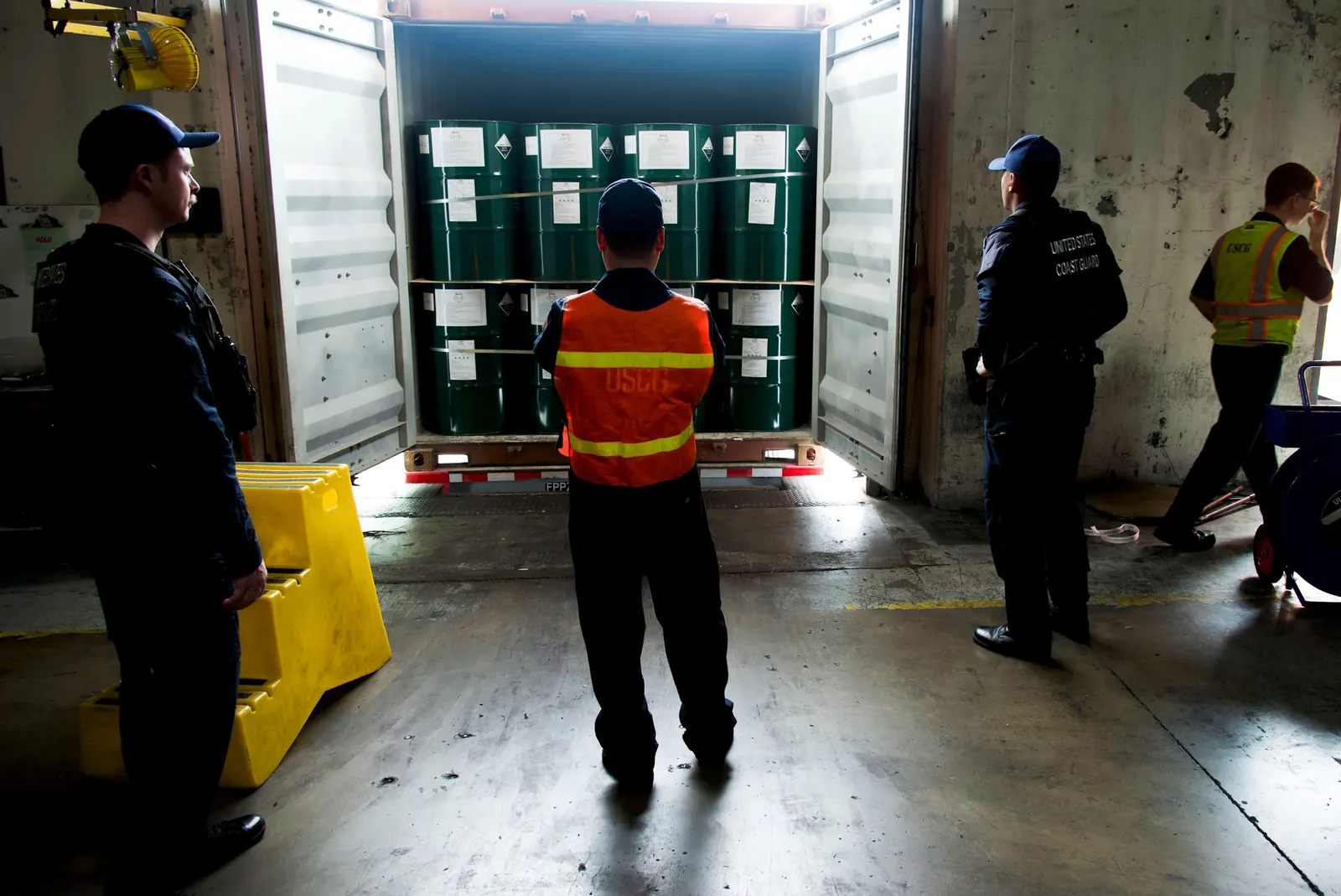
U.S. Coast Guard personnel inspect a container unloaded at Long Beach during a joint operation with U.S. Customs and Border Protection, June 7, 2025. U.S. Coast Guard photo by Petty Officer 1st Class J.J. Huggins; public domain via DVIDS. Source.
Section 122 and Section 232 Do Not Simply Stack
The February proclamation says the Section 122 surcharge does not apply in addition to a Section 232 tariff. If Section 232 applies only to part of an imported article, the 10% surcharge can apply to the non-232 portion but not to the part already subject to Section 232. This is important for derivatives whose dutiable metal content is separated from the value of non-metal content.
That is why a calculator that always adds “MFN + 301 + 122 + 232” can overstate the bill. Our updated US tariff and landed-cost calculator blocks that double count when Section 232 is entered for the full customs value and warns users that mixed-content entries need a broker calculation.
De Minimis Is Still a Separate Issue
The February 20 de minimis executive order continued the suspension of duty-free treatment under 19 U.S.C. 1321(a)(2)(C) for covered shipments regardless of value, country of origin, transport mode or method of entry, subject to the order's stated exceptions and separate postal procedures. The end of the former IEEPA duties did not itself restore the $800 exemption.
For importers using direct-to-consumer parcels, the operational impact is larger than a single rate change: shipments need accurate origin and value data, an appropriate entry process, and a carrier able to transmit and collect the required duties.
FY2026 MPF and HMF Numbers
CBP states that the formal-entry Merchandise Processing Fee is 0.3464% of imported-goods value, excluding duty, freight and insurance. For fiscal year 2026, the minimum is $33.58 and the maximum is $651.50; manually filed entries have an additional surcharge. CBP states that the Harbor Maintenance Fee is 0.125% of commercial cargo value for applicable port use and is not collected on air cargo.
| Item | July 14 status | Importer action |
|---|---|---|
| Section 122 surcharge | 10% being collected; scheduled through July 24 | Model both entry-date scenarios |
| China Section 301 | Still separate and product-specific | Confirm HTS and exclusion eligibility |
| Section 232 | Sector/product specific | Separate covered and non-covered value |
| De minimis | Suspension continued | Confirm carrier and entry workflow |
A Seven-Step Checklist Before Your Next US Entry
- Confirm the 10-digit HTS code. Do not use a broad label such as “electronics” or “furniture” as the legal classification.
- Check all duty layers. Record Column 1, Section 301, Section 232, exclusions and possible AD/CVD separately.
- Use the entry date. Ask the broker which date controls the surcharge for the planned shipment.
- Run two landed-cost scenarios. Compare the current rule with a no-Section-122 scenario; do not book margin based only on the lower case.
- Do not double-count 122 and 232. For mixed-content derivatives, get the value allocation reviewed.
- Keep origin and value support. Supplier invoices, bills of materials, payment records and production evidence should match the customs declaration.
- Recheck official instructions before entry. July policy can move faster than a sea shipment.
Practical sourcing takeaway: tariff uncertainty is a reason to improve documentation, not to change classification or value artificially. Negotiate product cost and shipping terms, verify origin, and compare entry timing legally—but never ask a supplier to understate value or use an inaccurate HS code.
Official Sources and Current Reporting
- White House: Temporary Import Surcharge proclamation (Feb. 20, 2026)
- Federal Register: Section 122 proclamation and implementation text
- White House: Ending Certain Tariff Actions
- White House: Continuing the Suspension of Duty-Free De Minimis Treatment
- USTR: China Section 301 exclusions extended into November 2026
- USITC: current Harmonized Tariff Schedule
- CBP: FY2026 Merchandise Processing Fee
- CBP: Harbor Maintenance Fee
- Associated Press: Federal Circuit permits continued collection during appeal (June 11, 2026)
Frequently Asked Questions
Is Section 122 definitely ending on July 24?
That is the end time written into the proclamation, absent earlier change or congressional extension. Importers should wait for current CBP instructions before treating the lower scenario as final.
Will Chinese goods become tariff-free?
No. Normal HTS duties and applicable Section 301, Section 232, AD/CVD and customs fees are separate.
Can Abel Sourcing give a binding customs classification?
No. We can organize product specifications, supplier records, bills of materials and shipping data for your broker. A licensed customs broker or a CBP ruling should be used for formal classification decisions.
Need the Product Data Before Your Broker Can Quote?
We help buyers collect factory specifications, component values, packing data and origin evidence, then coordinate the handoff to the buyer's customs broker and forwarder.